
Meet a change agent: Alba Kruja turns students into sustainable entrepreneurs
For nearly two decades, Professor Alba Demneri Kruja a has been a driving force at Epoka University in Tirana, Albania. Since the university’s establishment in 2007, she has taught entrepreneurship and strategic management across bachelor, master and PhD levels - always with a strong focus on how education can contribute to a more sustainable future.
Around ten years ago, Alba experienced a turning point in her teaching. Through close collaboration with local startups and the entrepreneurial ecosystem in Tirana, she realized that entrepreneurship should not be framed solely around profit maximization. Instead, it should be understood as a powerful tool for addressing societal and environmental challenges. As well as in business as in the classrooms.
“At the time, we started designing our courses more holistically at Epoka, aligning learning outcomes, teaching activities and assessment with sustainability competencies,” Alba explains.
Today, sustainability is no longer an add-on for her, but a core lens - one that now shapes all courses at Epoka and runs through every educator and student’s mind.
From student analysts to entrepreneurs
Alba’s teaching philosophy is deeply student-centered and rooted in real-world practice.
“My teaching philosophy is student-centered and experimental. I believe that students learn best when they work on real-world challenges and critically reflect on the impact of their decisions,” she explains.
Reflection, peer-to-peer learning and engagement with external stakeholders are key elements in her classroom.
One concrete example is how Alba redesigned her Operations Management course. Instead of doing traditional company analyses, students now identify actual sustainability challenges in existing businesses and develop new products or services using responsible and innovative solutions. Here, she integrates tools such as the Sustainable Business Model Canvas, developed by colleagues from the Sustainability for Future project - enabling students to act as entrepreneurs, not just analysts.
Empowering students to take the global stage
This past semester, Alba’s entrepreneurial mindset has been further strengthened through Start for Future initiatives, especially the LEARN program, where around 40 of her students pitched their ideas to an international jury of professionals. For Alba, this moment is crucial. The pitching process itself becomes a learning journey where students iterate their ideas, refine their business models and learn to communicate actual impact - not just economic value.
Being exposed to global experts gives students something the traditional classroom rarely offers: a sense that their ideas matter beyond the university. Here Alba points out how they experience what it means to think globally and act locally: “They [students] see the impact that they might have beside the classrooms, to be exposed to a global ecosystem and global experts, not only the national experts.”
Today, several of Alba’s students continue developing their projects after the course, turning them into startups, social initiatives or competition entries.
Shifting mindsets in higher education
Beyond formal education, Alba has also spent more than a decade as advisor to the Innovator Students Club, where students mentor high school pupils through bootcamps focused on sustainability and entrepreneurship.
As she explains, “we see the value chain starting with high school students. This mindset shift needs to begin early, by raising awareness on sustainability and problem-solving skills through practice.”
Still, innovation in education is not without obstacles.
“The biggest challenge is actually changing this mindset - moving away from traditional exam-driven education towards more flexible experiential and interdisciplinary approaches,” Alba says. And that change, she believes, must start with educators themselves.
Embedding sustainability through Sustain4Future
This is where Sustain4Future plays a key role. Through the project, Alba and her colleagues have already gained a more structured and outcome-oriented approach to integrating sustainability across curricula. A new framework has supported holistic course design, alignment of learning outcomes, and stronger interdisciplinary collaboration at Epoka University.
Perhaps most importantly, she points out that Sustain4Future has contributed to a shared institutional understanding: sustainability is treated as a strategic priority, supported by revised curricula and internal structures such as a new established ESG team, which measures and reports sustainability impact at Epoka University.
Becoming a change agent
For Alba, sustainability is not just an academic concept - it is a way of thinking, choosing and acting every day.
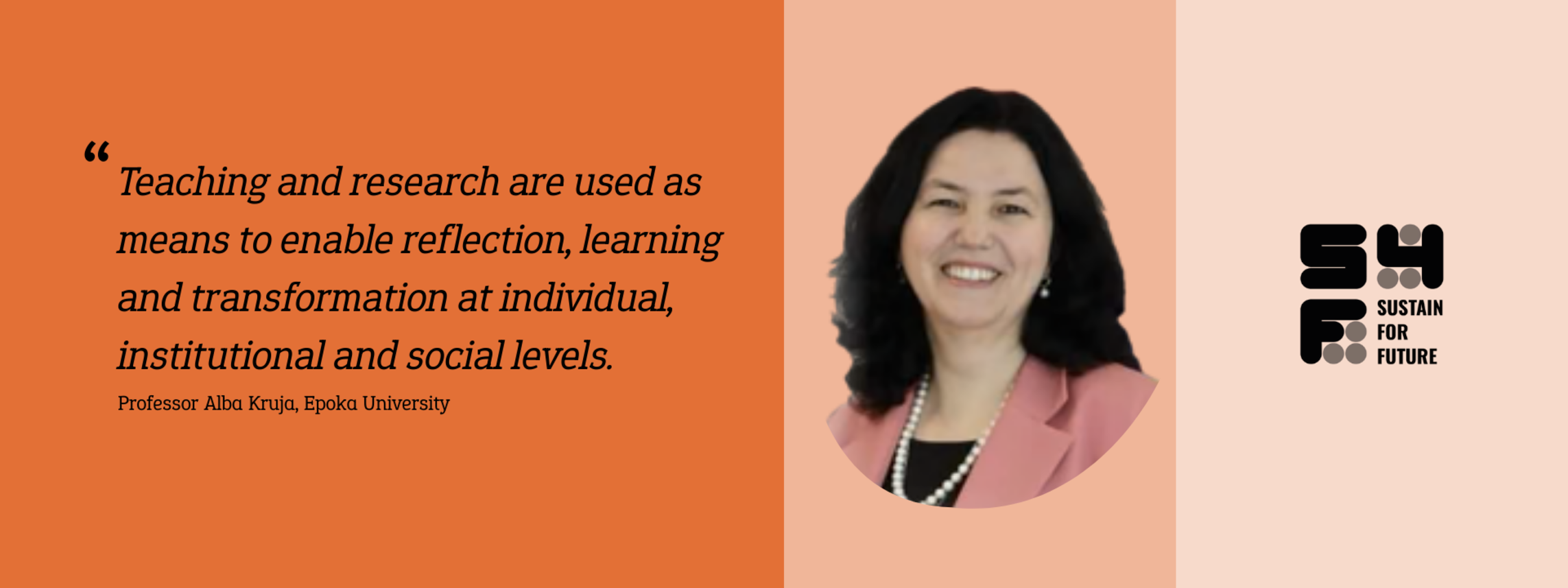
“I consider myself a change agent, using teaching and research as tools to enable transformation at individual, institutional and social levels,” she says.
But transformation, she insists, starts from within. Through self-reflection and everyday decisions, educators shape not only their students, but also their institutions and, ultimately, society.
And her message to fellow educators is clear: be authentic, be collaborative - and remember that education is one of the strongest drivers of sustainable change.