
What a student startup taught Anu Olvik about teaching sustainable finance
2005: A student venture built on courage and action
The music is loud, the party venue R.i.f.f. is filling up, and as guests arrive, they are handed small, carefully designed patches - green if you’re single, red if you’re taken.
Behind this event idea is not a company of seasoned entrepreneurs, but a group of 18-year-old students experimenting with creativity, communication and business. One of them is Anu Olvik.
What began as a student initiative quickly became a hands-on entrepreneurial experience, where value was created not just through a product, but through interaction and connection between people. Knocking on venue doors and picking up the phone, Anu embraced learning by doing from the very beginning.
What started with fun and curiosity soon revealed something deeper: an understanding that entrepreneurship is about creating meaning and engagement, not just selling a product.
And the idea had real impact. 21 years ago, Anu and her team placed 3rd in the Estonian Student Company of the Year. Soon after, their patches appeared across Tallinn with small expressions of mood, message and connection.
For Anu, the experience shaped a mindset that still defines her teaching today: entrepreneurship is not something you only study, but something you actively create, test and experience in the real world.
Integrating sustainability into financial thinking
Today, Anu teaches at the Estonian Entrepreneurship University of Applied Sciences (EUAS), where she brings that same practical mindset into her work with finance and sustainability.
Rather than treating sustainability as a separate topic, she embeds it directly into financial reasoning. Because for her, finance is not only about performance, but about responsibility.
“Sustainability in finance is about understanding the consequences of decisions. Not only economically, but also socially and environmentally,” she explains.
This approach challenges students to rethink traditional financial logic and consider long-term value creation, risk and impact in a broader sense.
Ülemiste City: The living classroom
Situated in the heart of Ülemiste City in Tallinn, the university benefits from a unique ecosystem where education and industry meet. Surrounded by startups, scale-ups and established companies, students at EUAS are constantly exposed to real-world business environments.
As an educator, Anu actively brings this unique context into her teaching. By engaging with companies and professionals in the area, students gain direct insight into how financial decisions are made in practice. As she notes, “being close to companies allows students to connect theory with practice in a very direct way. The concept is that the university can give back to the companies located in the city and vice versa. So, as an educator I can benefit a lot from that.”
Balancing life-long learning
At EUAS, Anu sees both herself and her institution as part of a broader shift. Not only in how entrepreneurship is taught, but in how sustainability is understood and embedded into their mindsets more and more over the past years. But for Anu, being that kind of front runner does not mean having all the answers. It also means staying open to being challenged. And often, that challenge comes from her own students.
As she shares as an example, some students have questioned the use of AI tools in financial forecasting, pointing to the environmental cost behind the technology:
“They told me - why should we use AI for this, when it consumes so much water?”
For Anu, moments like these are not obstacles, but signals of meaningful learning. And for that, she is very proud of her students. They reflect a new generation that not only understands sustainability but actively applies it - even when it means questioning established practices.
At the same time, Anu holds a deep respect for the individual journeys of her students. Because beyond methods and mindsets, she sees education as something deeply human.
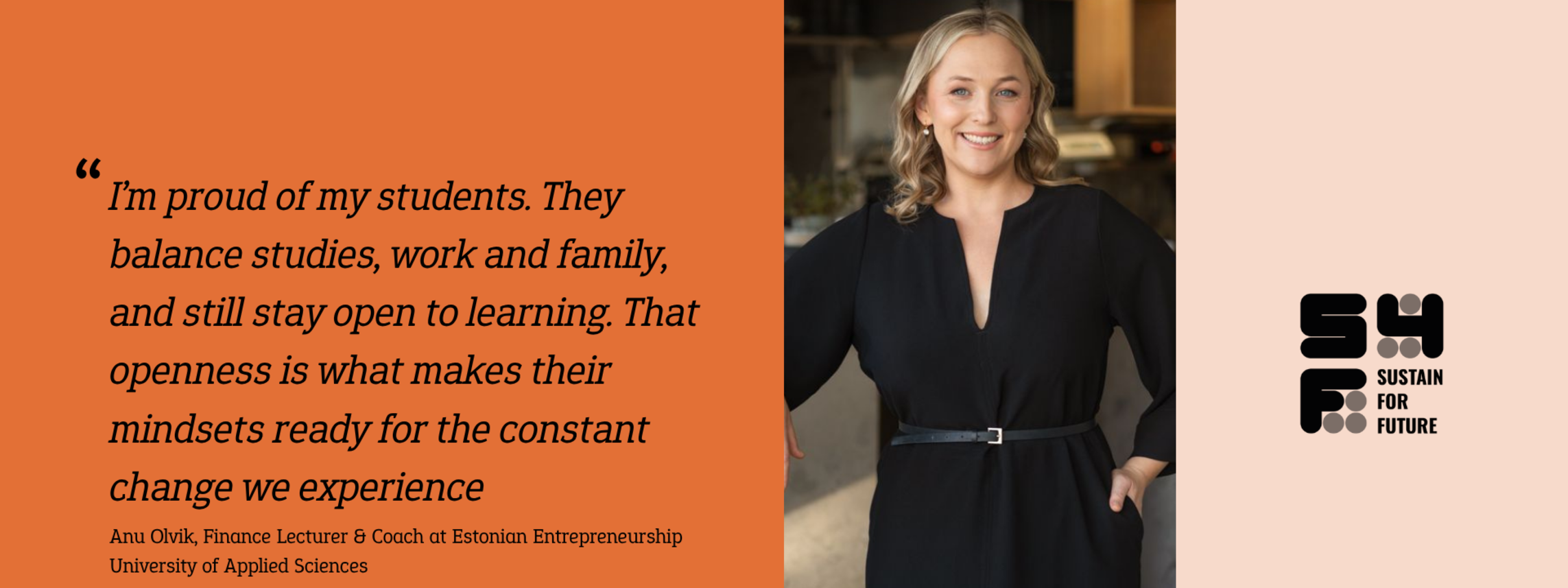
“I’m proud of my students. They balance studies, work and family, and still stay open to learning. That openness is what makes their mindsets ready for the constant change we experience,” she tells.
Strengthening perspectives through Sustain4Future
Through the Sustainability for Future project, Anu has further developed her approach to integrating sustainability into finance education, while collaborating closely with international colleagues.
Her key takeaway from the collaboration is the importance of having perspective.
“We all understand sustainability in slightly different ways, but when we take the time to clarify our perspectives, we work much better together,” she reflects.
For Anu, this mindset is essential - not only in international partnerships, but in education itself. Because preparing students for the future is not just about knowledge, but about developing awareness, responsibility and collaboration needed to create meaningful change.